A new technological innovation of Artificial Intelligence is being deployed by 10 private tech corporations faster than many citizens, businesses, and governments can evaluate and regulate its effects.
In the U. S., the development and deployment of the new technology is under the control of the private AI corporations. The code and algorithms are the closed, private proprietary property of the 10 companies.
In the near future, the new tool has the potential to mimic human behavior and then write its own algorithms to monitor citizens, free from human control.
After the AI escapes human control, the 10 companies do not have the ability to terminate the technology, or to fix its flaws
Uncontrolled and unregulated corporate self-volition AI has the potential to become tyrannical, as seen in both the deployment of the social credit system in China and the DEI free speech tyranny in the U. K.
In both China and the U. K, the threat to citizen liberty arises from the fusion of government power with large private corporations, who benefit financially from the deployment of the technology, such as the case in the U. S. with the deployment of the Flock surveillance cameras.
This fusion of power between government and AI corporations is more dangerous to citizens than earlier trends in technology automation because citizens no longer have recourse through a fair election system to enforce the consent of the governed.
The 10 corporations have a political and financial incentive to evade government regulatory control because the companies have invested billions of risk capital to commercialize their technology.
Government regulation would jeopardize the company’s from obtaining a profit on their speculative capital investments.
The threat of uncontrolled, unregulated corporate AI is an immediate present danger to the liberty of American citizens.
As Breitbart News reports, employees of the big AI corporations are trying to warn the public.
Anthropic Researchers Go Public with Fears AI Could ‘Kill All Humans’ Within a Decade, Breitbart News, Sept 9. 2026.
“The essay describes AI as moving toward recursive self-improvement, in which systems advance without human direction, and says capability gains are likely to continue or even speed up. “I am concerned no one is prepared for the consequences of a continued rapid rise in machine intelligence,” Pachocki wrote…a model’s step-by-step reasoning to catch problems, saying its effectiveness is eroding. He named three causes: the boundary between a model’s internal reasoning and its supervised communication with people is dissolving, models are increasingly shaping their own reasoning chains, and capability gains are showing up even without any verbal reasoning output to monitor.”
American citizens are not passive, helpless, observers to watching their liberties vanish.
Jefferson and Mason used the ancient values that individuals are “endowed” by God with natural rights in order to explain the modern ethical values of self-government and consent of the governed.
As early as 1773, Mason wrote that,
“English subjects could be governed only by laws to which they had given their consent through representatives freely chosen by themselves.” (Trevor Colbourn, The Lamp of Experience: Whig History and the Intellectual Origins of the American Revolution, 1998).
Three years later, on May 20, 1776, Mason wrote The Virginia Declaration of Rights, which was adopted unanimously at the Fifth Virginia Convention at Williamsburg, Virginia on June 12, 1776.
While Mason was a delegate to the Virginia convention, in Williamsburg, Jefferson was a delegate in Philadelphia, at the Second Continental Congress.
Jefferson wrote a draft of the Virginia Constitution, for the delegates in Williamsburg, at the same time that he was writing the Declaration of Independence. Jefferson’s draft of the Virginia Constitution contained the ethical values and principles of Locke, Kant and Smith.
The Virginia Constitution was adopted on June 29, 1776, and contained the principles of government outlined by Jefferson, in his draft.
In 1830, Mason’s Declaration of Rights was incorporated within the Virginia State Constitution as Article I.
In both Declarations, citizens have natural rights, in the pre-constitutional period, that exist prior to the formation of civil government, that no future government can eliminate.
After the pre-constitutional rules have been established, laws and the authority of government is legitimate only because the people authorized it and consented to be governed by the laws that they had given to themselves.
American citizens have an on-going right to withdraw their consent of an abusive government, including the right of revolt or rebellion to abolish tyranny.
In Mason, this right of rebellion is invoked when,
Section III): “And that, when any government shall be found inadequate or contrary to these purposes, a majority of the community has an indubitable, inalienable, and indefeasible right to reform, alter, or abolish it, in such manner as shall be judged most conducive to the public weal.”
In Jefferson,
“That whenever any Form of Government becomes destructive of these ends, it is the Right of the People to alter or to abolish it, and to institute new Government, laying its foundation on such principles and organizing its powers in such form, as to them shall seem most likely to effect their Safety and Happiness.”
Jefferson and Mason synthesized ancient Western Civilization ethical principles, using the imaginary state of nature of Hobbes and Locke, to describe the ethical values in the post-constitutional period, on the logic of why citizens would voluntarily continue to obey the unwritten rule of law.
Their declarations (Virginia Declaration of Rights, and Declaration of Independence) assert that government’s continuing legitimate authority rests upon permanently securing pre-constitutional rights of life, liberty, and the fruits of one’s labor.
Their declarations have the appearance of a social contract, or a covenant among citizens, when the patriots of 1775 agreed upon rules that they would follow after they left the state of nature to form civil society.
The end goal of government is the eudemonia of citizens, a society where citizens flourish by seeking the futures that their brains are imagining.
When the ancient values are synthesized into modern principles of limited government power, the purpose of government, described by Jefferson and Mason are the creation of institutions that:
- Provide equal legal protection of the rights of persons and property from arbitrary government power,
- Clear rules of legal contract and judicial enforcement mechanisms,
- Decentralized state sovereignty of economic decision-making to facilitate economic growth and technology innovation,
- Legal incentives for entrepreneurs and venture capitalists to appropriate what is due them in distant future contractual promises,
- Legal protection of knowledge creation and diffusion institutions that create equal open upward pathways of economic mobility and income diffusion to all citizens.
Following the priniples of Locke, Kant, Mason, and Jefferson, citizens, today, have both natural rights, and moral obligations to protect each other from tyranny.
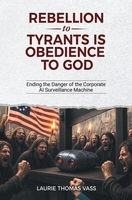
Our new book is about how citizens discharge their obligations to each other in rebellion to the danger of corporate AI totalitarianism.

About Laurie Thomas Vass: She is an economist and constitutional theorist who believes American political polarization has reached a point where red state citizens must craft alternative governing systems that reconstruct the relations between states and the national government.
https://gabbypress.com/2023/08/16/meet-the-author/
About the book: The book is available at the Gabby Press website, with a direct link to Ingram for fast printing and shipping. Buyers at Gabby Press get a 10% discount off the retail selling price, to help defray the costs of standard shipping.